
Editorial
Trends in demographic concentration in cities have contributed to a significant worsening of housing problems worldwide, hampering universal access to decent housing. In the last year, as a result of the COVID-19 pandemic crisis and the successive demands for the lockdown of populations, especially in cities, housing has gained an increased relevance for families, with a marked impact on social inequalities.
How to guarantee humanly acceptable confinement conditions for populations living in degraded housing, without healthy conditions, overcrowded, with little or no access to basic services, among other needs? On another level, how to reconcile in the domestic space all the 'new' functions of school, office and leisure?
The conditions of habitability and the quality of housing have undoubtedly turned out to be conditioning variables of public health measures, somewhat refocusing the debate and the urgency of public policies on housing. The relationship between housing and the public space and with the urban functions of proximity also took on another dimension, requiring systemic approaches to housing problems.
In Portugal, it is possible to say that housing problems never ceased to exist, despite the different cycles of housing policies and successive policy instruments aimed at providing solutions to situations of housing scarcity, lack of housing conditions, clandestine housing, of degradation or overcrowding of the housing stock. Although concentrating especially in the two metropolitan areas, Lisbon and Porto, either within their historical centres, or in the areas of more recent expansion and in the peripheries, the truth is that, in recent years, the difficulties in securing decent housing for all citizens have tended to extend to other Portuguese towns and cities, medium or small, including in rural areas where more significant migratory movements have been accentuated (see, for example, the case of Odemira and the recent situation of Asian communities settled there that pose a great set of challenges from this point of view).
The New Generation of Housing Policies (NGHP) aims precisely at providing a global and integrated response to the immense diversity of challenges that arise in this area and to the importance, aggravated by the pandemic, of housing problems and needs, justifying the announced symbolic goal of guaranteeing that we can celebrate the 50th anniversary of the 25th April with no families in unworthy housing situations. This goal is certainly ambitious, but it fundamentally assumes that everyone, public and private, will be called upon to participate actively in a more effective and responsible governance model of housing policies.
Quaternaire Portugal brings together a set of skills and experiences that allow it to foresee an attentive and collaborative position within the context of changes that NGHP is introducing. In this sense, the company has been preparing to respond to the needs of updated and in-depth diagnoses of the housing needs of each municipality and of exhaustive surveys of the resources that can be mobilised locally for the different responses, with a view to formulating strategies and action plans aimed at taking advantage of either the new public financing instruments (for example, the strengthening of the Support Programme for Access to Housing, within the scope of the Recovery and Resilience Plan - PRR), or of the market itself.
The Board
The experience of Quaternaire Portugal
The issue of housing has been present in the activity of Quaternaire Portugal practically since its foundation, as a transversal domain or as a central focus of projects in different work areas.
This is, of course, an unavoidable topic in planning, due to its relationship with the territory, with the economy and with society in general. It is inseparable (in an interactive logic) from demographic and social dynamics, the economy and employment, land use discipline, urban regeneration, etc.
As is typical of the activity of a consulting company, working essentially for the Portuguese public administration market, at national, regional, supramunicipal and local levels, Quaternaire Portugal's approach to housing issues has adapted to the evolution of concepts, models and public policy instruments.
A clear example of this evolution is the way in which urban regeneration policies, which have always been closely related to the subject of housing, have evolved over time, responding to social needs, to more holistic and forward-looking views of cities, including more recent logics of return to urban centres, in contrast to the dynamics of urban growth by expansion. The main instruments of this policy - from the regeneration programmes of degraded urban areas, to the several generations of European support and incentive programmes for the regeneration, revitalisation and rehabilitation of urban areas, passing through the legal regime of urban regeneration, and currently, the NGHP - they looked at housing in different ways, from the social response, the object that helps to configure the territory to the tradable economic good. The same observation could be made, moreover, in terms of spatial planning or strategic urban or regional planning (planning of services and proximity equipment, strategic city plans, innovative urban actions, etc.).

In addition to this more comprehensive approach, in which housing is a planning 'topic', Quaternaire Portugal has also carried out some works focused specifically on housing issues, as mentioned above, which remains a very relevant domain in the company's activity. Some examples are:
-
Porto Downtown Revitalisation Programme - Housing (2001, Sociedade Porto 2001 / Municipality of Porto);
-
Evaluation of the Youth Rental Incentive programme (2006, National Housing Institute);
-
Market research on housing rents (2008, IHRU);
-
Evaluation of the “Porta 65 Jovem” Programme (2009, IHRU);
-
Evaluation of the “PER Famílias” Programme (2011, IHRU);
-
Basic Law of the East-Timor Housing Policy (2014, Government of East-Timor);
-
Impact assessment of the creation of the Entry Manager position in social housing units (2016, Domus Social - Municipal Housing Company of Porto);
-
Collaboration with several Municipalities and Municipal Housing Companies in projects for the integration of disadvantaged communities, energy efficiency in municipal housing and preparation of applications for public, national and European financing instruments (since 2008).
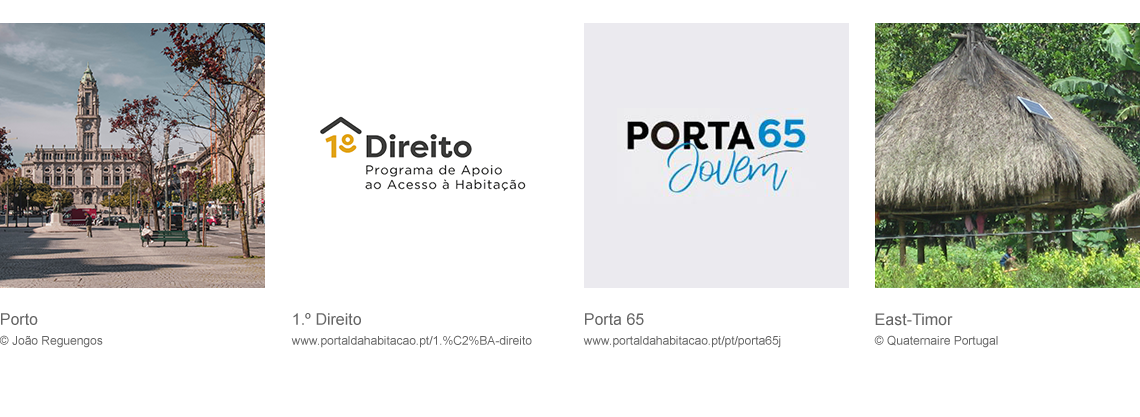
Currently, it is the instruments of the NGHP and the Basic Housing Law that define the mainstream of the consultancy market in this field. In this context, Quaternaire Portugal is currently collaborating with the Municipalities of Matosinhos, Póvoa de Lanhoso, Santo Tirso, Torres Vedras, Valongo and Viana do Castelo, in the respective Local Housing Strategies.
On the other hand, in the context of the review of several Municipal Master Plans in which it is involved, Quaternaire Portugal has also been preparing a methodology for the elaboration of Municipal Housing Charters.
It is expected that some transformations will take place in this market - new products, new approaches, new public policy instruments - resulting from the social and economic crisis caused by the COVID-19 pandemic, but also from the consequent investment reinforcements foreseen in some important plans, programmes and instruments to support the country's economic and social recovery, as is the most recent example of the PRR, which provides for a significant increase in funds for housing. Quaternaire Portugal will be prepared for this challenge.
Our view on the current framework of Housing Policies in Portugal
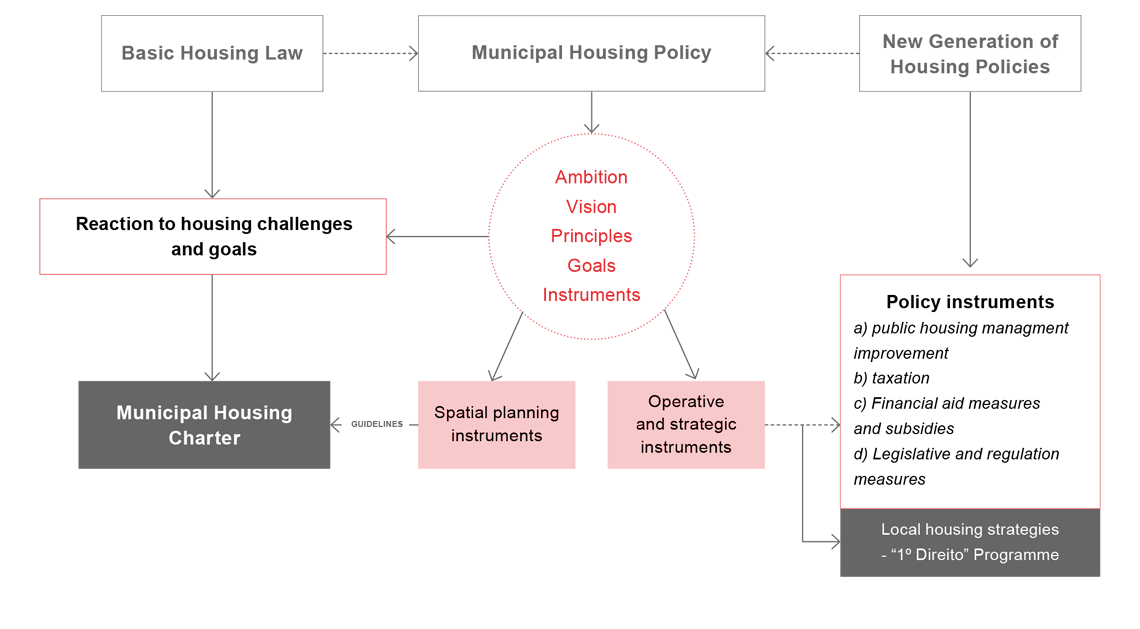
The various legal and financial instruments created to improve citizens' access to decent housing pose significant challenges in terms of their application. One of these challenges corresponds to the interaction of the municipal housing policy with that of spatial planning.
Local Housing Strategies (LHS), whose elaboration is required of Municipalities wishing to apply for the “1.º Direito” Programme - Support Programme for Access to Housing, are, according to the respective legal framework, limited instruments when it comes to their scope, since they only cover families that live in housing conditions considered unworthy.
The effort placed in the diagnosis of the territory that takes place in the context of an LHS, in relation to the identification of the housing needs of a municipality could be, in many cases, more useful if it properly explored the social scope of the NGHP - that is, if it were not limited only to the most deprived families. It is argued, therefore, that the elaboration of an LHS should seek to identify all the problems that the community faces in the matter of housing, betting on the diversity of responses, translating into a true Municipal Housing Policy.
Such an option will allow to frame the applications to all financing programmes to promote housing solutions, in addition to the “1.º Direito” Programme, as well as to envisage financing opportunities in new or renewed financing instruments, with emphasis on those that may arise within the framework of Portugal 2030 Programme.
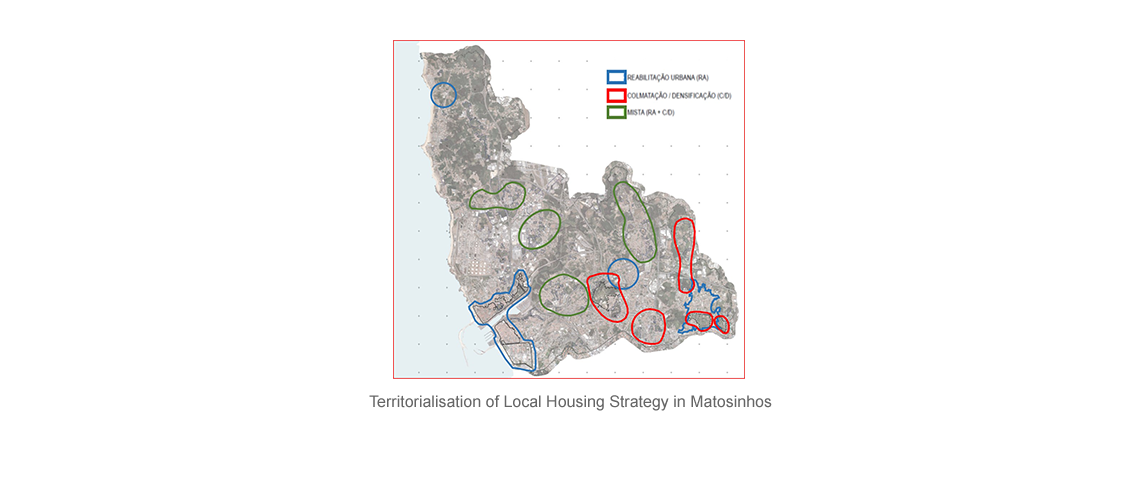
In a Municipal Housing Policy, the territorialisation of housing problems and solutions emerges as an essential work axis for the implementation of the strategy. Problems to be territorialised include, among others, situations of housing shortages, areas of concentration of urban and social problems, as well as areas of greater real estate pressure. In terms of housing solutions and responses, territorialisation must include, among other aspects, the location of housing resources potentially mobilisable for the strategy, such as real estate stock, public and private, vacant and land with constructive capacity, and the typification of solutions to privilege as a response to the identified deficiencies.
It is precisely in the field of territorialisation of LHS options that the main interactions between the municipal housing policy and that of spatial planning and urbanism are identified. And it is also in this scope that the focus of the Municipal Housing Charter (MHC), provided for in the Basic Housing Law, is an instrument that proves to be more comprehensive in terms of 'target audience' and with a more strategic and prospective character than LHS.
Indeed, MHC presupposes:
-
The identification of housing resources and local potential, namely in expectant urbanised land, in abandoned urbanisations or buildings and in vacant, degraded or abandoned dwellings;
-
The identification of the needs for urbanised land and the rehabilitation of buildings that respond to housing shortages and the need for relocation due to housing degradation, at a social or urban level, of the agglomerate or of the building.
In this context, we understand that until the regulation of the Basic Housing Law, the broad approach to housing problems at the municipal level within the scope of LHS allows an exercise of prior strategic planning that, in a second phase, will facilitate the required spatialisation in the MHC.
It is, therefore, within this conceptual and methodological framework that Quaternaire Portugal seeks to support its customers in matters of public housing policy, at a time when the topic gains particular importance in Portuguese society, if we take into account the current context of growing needs at this level, in which housing shortages are heightened, as well as the corresponding financing of solutions.